
Welcome back! In our last tutorial, we learned how to build and organize methods. We also learned how Java uses a “Call Stack” to keep track of variables every time one method calls another. That last detail turns out to be exactly the mechanism that makes today’s topic possible: what happens when a method calls itself? Today, we are going to melt your brain a little bit as we dive into Java Recursion.
Table of Contents
- To Understand Recursion, You Must First Understand Recursion
- What Is Recursion?
- The Base Case and Recursive Case
- Classic Example: Factorial
- Tracing Recursion with the Call Stack
- Classic Example: Fibonacci (And Why It Is Dangerous)
- Classic Example: Summing an Array
- Recursion vs Iteration
- Stack Overflow: When Recursion Goes Wrong
- A Note on Tail Recursion
- Code Walkthrough: Recursive Toolkit
- Common Mistakes Beginners Make
- Best Practices in the Real World
- Performance Considerations
- Frequently Asked Questions (FAQ)
- Interview Prep Questions
- Test Your Knowledge (MCQs)
- Practice Coding Questions
- Hands-On Assignment
- Mini Challenge: Recursion vs Iteration Race
- Summary and Cheat Sheet
To Understand Recursion, You Must First Understand Recursion
There’s a classic (and slightly nerdy) joke in programming: “To understand recursion, you must first understand recursion.” Playful as that is, it captures something very real.
Recursion can feel conceptually slippery the first time you encounter it because it asks you to trust that a huge problem can be solved by reducing it to a slightly smaller version of the exact same problem, over and over again, until it becomes completely trivial.
What Is Recursion?
Recursion is a technique where a method solves a problem by calling itself with a smaller or simpler input, until it reaches a version of the problem so simple it can answer it immediately.
static void countdown(int n) {
    if (n == 0) {
        System.out.println("Liftoff!");
        return;
    }
    System.out.println(n);
    countdown(n - 1);  // The method calls ITSELF, with a smaller input!
}countdown(3);Output:
3
2
1
Liftoff!
To write a method like this successfully, you need exactly two ingredients.
The Base Case and Recursive Case
- Base Case: The simplest possible version of the problem. This is the scenario you can answer immediately without calling the method again. This is what stops the recursion from looping infinitely. (In our countdown,
n == 0was the base case). - Recursive Case: The part where the method calls itself again, but with an input that is closer to the base case than before. (In our countdown, calling
countdown(n - 1)).
⚠ Common Mistake: If you forget to write a Base Case, or if your Recursive Case accidentally moves away from the Base Case, your method will call itself forever until your computer crashes.
Classic Example: Factorial
The factorial of a number (written n!) is the product of all positive integers from 1 to n.
Mathematically, it has a naturally recursive definition:
0! = 1(This is our Base Case)n! = n * (n-1)!(This is our Recursive Case)
Let’s translate that math perfectly into Java:
static long factorial(int n) {
    if (n == 0) {                  // BASE CASE
        return 1;
    }
    return n * factorial(n - 1);   // RECURSIVE CASE
}
System.out.println(factorial(5)); // Prints 120 (5 * 4 * 3 * 2 * 1)(Note: We use long here because factorial numbers grow so fast they will quickly break the int limit!)
Tracing Recursion with the Call Stack
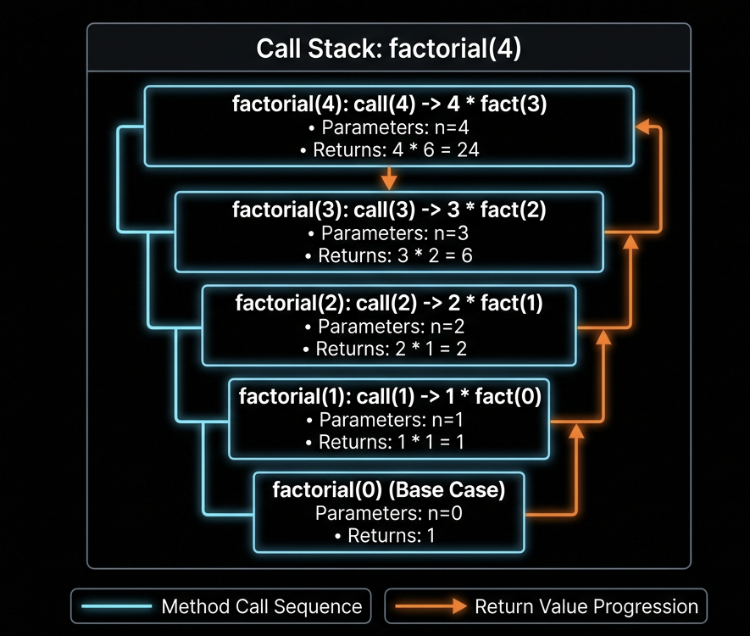
Let’s trace factorial(4) step by step, using the exact same Call Stack knowledge we learned in Part 10.
Recursion always happens in two phases.
Phase 1: Going “Down”
Each call pauses and waits for the answer from the call beneath it.
factorial(4)  → Needs factorial(3) first
   factorial(3)  → Needs factorial(2) first
      factorial(2)  → Needs factorial(1) first
         factorial(1)  → Needs factorial(0) first
            factorial(0)  → BASE CASE HIT! Returns 1 immediately.
Phase 2: Coming back “Up”
Each paused call wakes up, multiplies its own number by the result it just got back, and hands the answer up to the level above it.
            factorial(0) returns 1
         factorial(1) = 1 * 1 = 1
      factorial(2) = 2 * 1 = 2
   factorial(3) = 3 * 2 = 6
factorial(4) = 4 * 6 = 24  (The FINAL answer!)
Here is a visual representation of how Java builds those stack frames in memory:
Classic Example: Fibonacci (And Why It Is Dangerous)
The Fibonacci sequence is defined as: each number is the sum of the two preceding ones, starting from 0 and 1.0, 1, 1, 2, 3, 5, 8, 13, 21...
Let’s write it in Java:
static int fibonacci(int n) {
    if (n == 0) return 0;          // BASE CASE 1
    if (n == 1) return 1;          // BASE CASE 2
    return fibonacci(n - 1) + fibonacci(n - 2);  // TWO recursive calls!
}
This looks elegant, but notice how the recursive case makes two separate calls? This creates a massive, branching tree of methods calling methods.
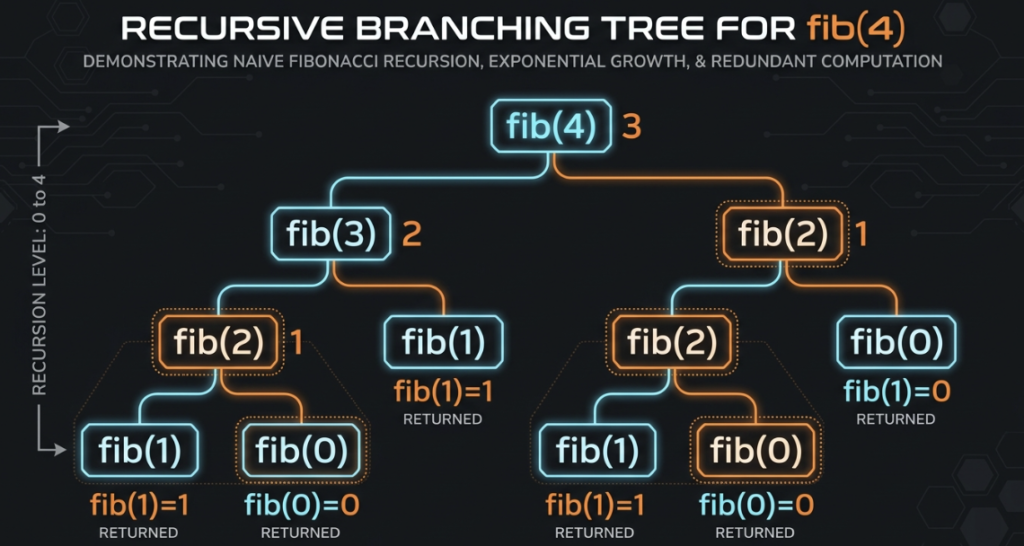
Look at that tree. To figure out fib(4), we had to calculate fib(2) twice! We had to calculate fib(1) three times!
If you try to run fib(50), your computer will freeze because it is needlessly recalculating the exact same numbers billions of times.
This is an incredibly important lesson: An elegant recursive solution is not always an efficient one.
Classic Example: Summing an Array
Let’s adapt an array loop into recursive logic!
static int sumArray(int[] arr, int index) {
    if (index == arr.length) {   // BASE CASE — we fell off the end of the array!
        return 0;
    }
    // Add the current number, plus the sum of everything after it!
    return arr[index] + sumArray(arr, index + 1);
}
int[] numbers = {10, 20, 30, 40};
System.out.println(sumArray(numbers, 0)); // Prints 100Notice how we pass an index parameter along for the ride? Since recursion doesn’t have a for-loop counter i, passing an index as an argument is how we keep track of where we are.
Recursion vs Iteration
Could we have solved that array sum with a simple for loop? Absolutely. It would have been faster and used less memory.
So when should you use Recursion?
- Use Iteration (Loops) for simple counting or flat lists (like arrays).
- Use Recursion for deeply nested, tree-like structures where you don’t know how deep the data goes.
Real World Example: If you are writing a script to calculate the file size of a folder, that folder might have sub-folders, which have sub-folders, which have sub-folders. A simple for-loop can’t handle an unknown depth like that. Recursion handles it flawlessly.
Stack Overflow: When Recursion Goes Wrong
Your computer’s Call Stack has a finite size. Every recursive call stacks a new frame of memory on top.
If you forget your base case, your program will stack frames infinitely until it runs out of RAM. When this happens, Java forcefully crashes the program and throws a StackOverflowError.
static void infiniteRecursion(int n) {
    System.out.println(n);
    infiniteRecursion(n + 1);  // NEVER reaches a base case! Grows forever!
}
// Eventually crashes with:
// Exception in thread "main" java.lang.StackOverflowError
A Note on Tail Recursion
Tail Recursion is when the recursive call is the absolute very last action in the method. Some programming languages automatically optimize tail recursion so it doesn’t consume extra stack memory.
Java does NOT do this. Even if you write perfect tail-recursive code, Java still builds a stack frame for every single call. If you go too deep, Java will crash with a StackOverflowError. This is a great piece of trivia for advanced interviews!
Code Walkthrough: Recursive Toolkit
Let’s combine some String manipulation with recursion!
public class RecursiveToolkit {

    public static void main(String[] args) {
        System.out.println("Reversed 'Java': " + reverseString("Java"));
        System.out.println("Is 'madam' a palindrome? " + isPalindrome("madam", 0));
    }

    // Strip off the first letter, reverse the REST, and tack the first letter on the end!
    static String reverseString(String s) {
        if (s.isEmpty()) {                       // BASE CASE
            return s;
        }
        return reverseString(s.substring(1)) + s.charAt(0);
    }

    // Two pointers moving inward.
    static boolean isPalindrome(String s, int left) {
        int right = s.length() - 1 - left;

        if (left >= right) return true;          // BASE CASE (Pointers met in the middle)

        if (s.charAt(left) != s.charAt(right)) return false; // Mismatch!

        return isPalindrome(s, left + 1);  // Move inward
    }
}
Common Mistakes Beginners Make
- Forgetting the Base Case. This instantly leads to a
StackOverflowError. - Moving away from the Base Case. If your base case is
0and your input is5, doingcountdown(n + 1)is going to walk you straight into infinity. - Thinking Recursion is automatically better. As we saw with the Fibonacci sequence, sometimes recursion causes massive performance issues due to redundant calculations.
Best Practices in the Real World
- Define the Base Case First. Before you write a single line of logic, put a comment saying:
// Base Case:and write it out. - Trace it on paper. If your recursion isn’t working, draw the call stack on a piece of paper for a small number like
3. You will instantly see where the logic breaks.
Performance Considerations
- Every recursive call requires Java to carve out a stack frame in memory. A loop uses virtually no extra memory.
- Method call overhead is generally very small, but if you recursively call a method 10,000 times, you will notice the lag.
Frequently Asked Questions (FAQ)
Q1. What happens if I forget a base case?
Java will throw a StackOverflowError and violently crash your program.
Q2. Is recursion slower than a loop?
Usually, yes. Building memory stack frames takes slightly more time than a simple i++ counter loop.
Q3. If loops are faster, why use recursion at all?
Because some problems (like navigating folder structures, parsing XML documents, or building AI decision trees) are incredibly difficult to write with loops, but beautifully simple to write with recursion.
Interview Prep Questions
Basic:
- What are the two mandatory components of a recursive method?
- What causes a
StackOverflowError?
Intermediate:
- Trace the call stack for
factorial(3). Explain the “going down” phase and “coming up” phase. - Why is the naive recursive Fibonacci implementation considered inefficient?
Advanced:
- Does Java optimize tail recursion?
- When would you actively choose recursion over iteration?
Test Your Knowledge (MCQs)
Q1. What are the two essential components of any recursive method?
a) A loop and a condition
b) A base case and a recursive case
Answer: b)
Q2. What is the time complexity of the naive recursive Fibonacci implementation?
a) O(n)
b) O(2ⁿ) (Exponential)
Answer: b) Because the tree doubles its branches at every single step!
Q3. Does Java optimize tail-recursive calls to avoid stack growth?
a) Yes
b) No
Answer: b) No. Deep recursion in Java is always dangerous.
Practice Coding Questions
- Write a recursive method to calculate the power of a number (
base^exponent), without usingMath.pow(). - Write a recursive method to count the number of digits in a given positive integer.
- Write a recursive method to find the maximum value in an array.
Hands-On Assignment: Recursive Number Explorer
Create RecursiveExplorer.java:
- Implement a recursive method to reverse the digits of an integer (e.g.,
1234→4321). - Implement a recursive method to check whether a number is a palindrome (e.g.,
1221). - For each method, write a comment explaining exactly what the Base Case is.
Mini Challenge: Recursion vs Iteration Race
Write two versions of a method that sums all integers from 1 to n.
- One using a simple
forloop. - One using recursion.
Use System.nanoTime() to log the start time, run sum(10000), log the end time, and find the difference. Which one was faster? Did the recursion crash with a StackOverflow?
Summary and Cheat Sheet
- Recursion is a method calling itself.
- You must always include a Base Case to stop it, and a Recursive Case to drive the problem toward the base case.
- Every call adds a “frame” to the Call Stack, which resolves in reverse order.
- Recursion is amazing for nested, branching structures, but loops are better for flat lists.
Your Quick Recursion Cheat Sheet
| Concept | Explanation |
|---|---|
| Base Case | The simple scenario that returns immediately. |
| Recursive Case | The scenario that calls the method again. |
StackOverflowError | What happens when you forget a Base Case. |
| Phase 1 | Calls going “Down” and pausing. |
| Phase 2 | Paused calls waking up and returning data “Up”. |
Further Reading
- Oracle Java Tutorials: Defining Methods & Recursion
Conclusion
Take a deep breath. Recursion is notoriously difficult to grasp at first. If your head hurts a little bit, you are doing it right.
The secret to mastering recursion is to draw out the call stack on a piece of paper, just like the diagram we generated. Once you can trace the variables going “down” the stack and coming back “up,” you’ve won the battle.
And with that, you have officially completed all the core concepts of Java Foundations!
Next up in Part 12, we are going to combine everything you have learned (Loops, Arrays, Strings, Methods, and Conditionals) into your very first major Mini-Project!
Ready to test your skills? Check out Part 12 — Revision Checkpoint 1 + Mini Project!